
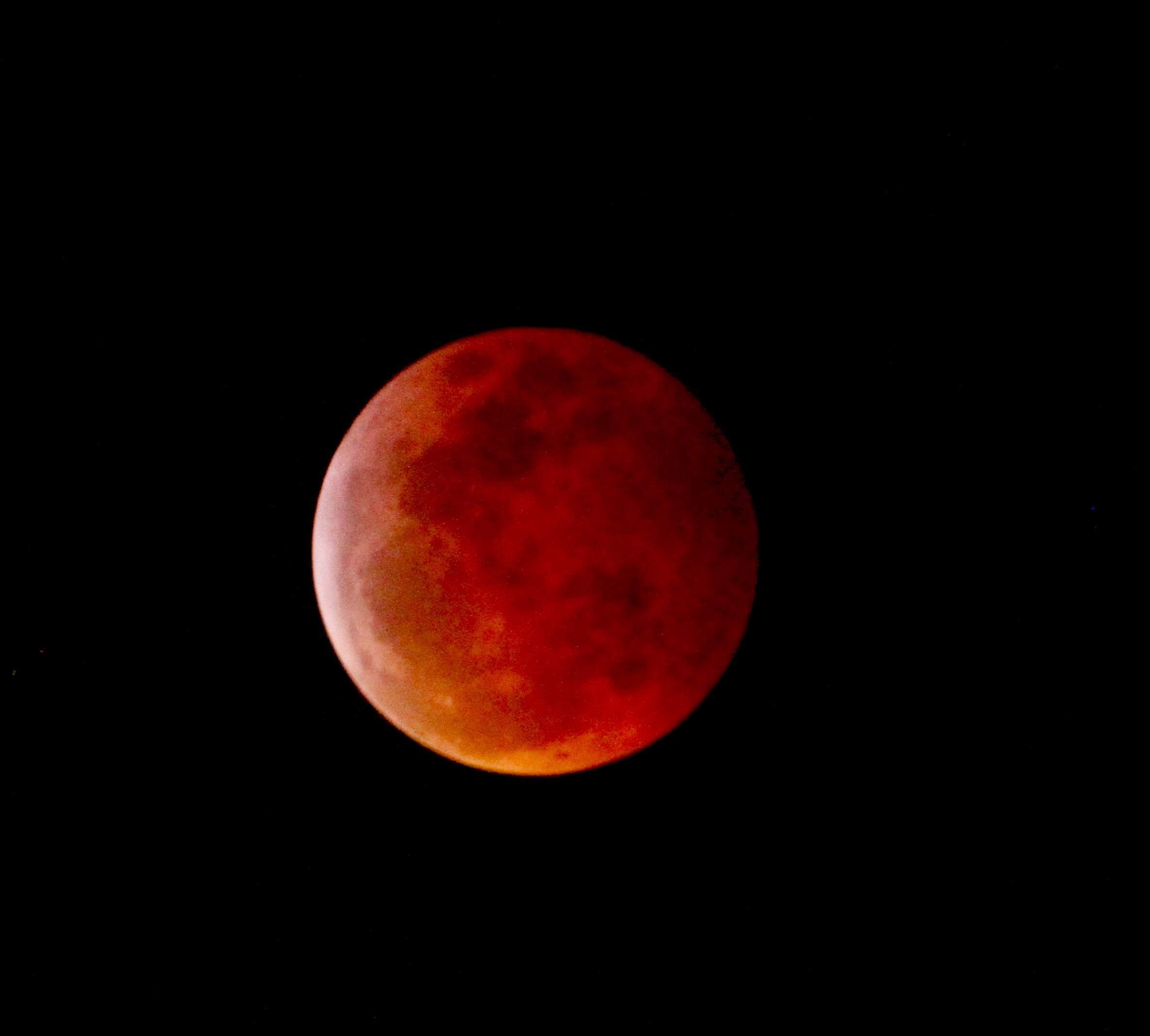
Skywatchers across much of the Americas, western Europe and western Africa were treated to a spectacular lunar eclipse overnight August 27–28, 2026.
The event was a deep partial lunar eclipse, with NASA reporting that 96.3% of the Moon’s disk entered Earth’s darkest shadow, the umbra. Although the eclipse came extremely close to totality, a small portion of the Moon remained outside the umbra, so it was not technically a total lunar eclipse.
As Earth’s shadow moved across the full Moon, the bright lunar disk gradually appeared to have a dark “bite” taken from it. Near the peak, most of the Moon was covered by Earth’s shadow and the eclipsed portion took on a dark copper, orange or reddish color.
That color happens because sunlight passing through Earth’s atmosphere is scattered and filtered before reaching the Moon. The remaining red and orange light can illuminate the lunar surface inside the shadow, creating the familiar “blood moon” appearance.
Where Was It Visible?
The eclipse was visible across North and South America, except Alaska and northwestern Canada, as well as parts of western Europe and western Africa. The best views depended on local timing and whether the Moon was above the horizon.
For much of the United States, the eclipse occurred during the evening and overnight hours of August 27. In Central Time, the partial eclipse began at approximately 9:34 p.m., reached maximum at about 11:13 p.m., and the partial phase ended shortly before 1 a.m.
No special equipment was necessary. Unlike a solar eclipse, a lunar eclipse can be viewed safely with the naked eye. Binoculars or a telescope simply provided a closer look.
For photographers and skywatchers, the nearly completely shadowed Moon offered one of the most dramatic lunar displays of 2026.
Bottom line: It wasn’t quite a “Blood Moon” in the strict astronomical sense because the eclipse never reached totality—but with 96.3% of the Moon inside Earth’s umbra, it certainly looked the part.
SEO Keywords
Primary: lunar eclipse 2026, August 2026 lunar eclipse, partial lunar eclipse, lunar eclipse tonight, blood moon 2026